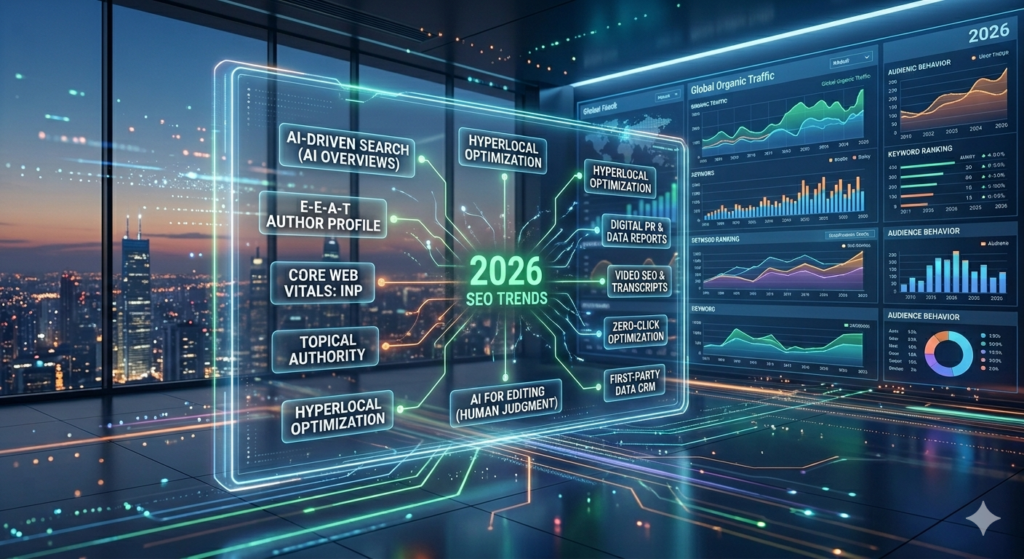
10 SEO Trends Every Digital Marketing Agency Must Follow in 2026
Category: SEO Strategy | Read Time: 8 min
The world of SEO is evolving faster than ever. In 2026, digital marketing agencies that rely on outdated tactics are losing ground to competitors who’ve embraced AI-driven search, authority-based content, and technical performance. Here’s what every agency needs to know.
1. AI Overviews Are Dominating the Top of Search Results
Google’s AI Overviews now appear in nearly 40% of all searches, pulling synthesized answers from multiple sources and pushing traditional links down the page. Agencies must optimize content with clear question-answer formatting, FAQ schema, and concise declarative answers so their clients get featured inside these AI-generated summaries.
2. E-E-A-T: Experience Is Now the Most Important Signal
Google now rewards content written by people with real, firsthand experience. Generic articles are being filtered out. Agencies must build proper author profiles with credentials, add first-person insights to content, and produce original case studies and proprietary data that prove genuine expertise.
3. Core Web Vitals — INP Is the New Standard
Interaction to Next Paint replaced First Input Delay as a Core Web Vital. It measures how quickly a page responds to every user interaction. Agencies must audit client sites for INP issues, reduce JavaScript bloat, and optimize third-party scripts to maintain strong technical SEO scores.
4. Topical Authority Outperforms Single Keywords
Google no longer ranks isolated pages — it ranks domains that comprehensively cover an entire subject. Agencies need to build content clusters with a central pillar page and multiple supporting articles covering every related question and subtopic in that niche.
5. Hyperlocal SEO Is Surging
“Near me” searches and city-specific queries are growing rapidly. Agencies managing local clients must go beyond a basic Google Business Profile and build dedicated location landing pages, gather consistent citations, generate reviews, and produce neighborhood-specific content.
6. Digital PR Is the Only Scalable Link Building Strategy
Low-quality guest posts and directory links no longer move rankings. In 2025, the only links that matter are earned through original research, data-driven reports, and thought leadership that journalists and editors genuinely want to cite. Agencies must invest in one major linkable content asset per quarter per client.
7. Video SEO Is Stealing Organic Rankings
YouTube videos now appear regularly in Google’s organic search results, especially for how-to and tutorial queries. Agencies that manage video alongside text content can help clients claim multiple SERP positions at once by optimizing YouTube titles, descriptions, chapters, and transcripts.
8. Zero-Click Optimization Is a Core Skill
Over 60% of searches now end without a click. Winning featured snippets, People Also Ask boxes, and AI Overviews still builds brand awareness even without a visit. Agencies must shift part of their KPI framework to track impression share and branded visibility, not just click-through rates.
9. AI Tools Are a Force Multiplier, Not a Replacement
Agencies using AI to bulk-produce generic content are being penalized. Those using AI for research, outlining, and editing — while keeping human expertise at the core — are thriving. Every agency needs a documented AI content policy that defines where human judgment is non-negotiable.
10. First-Party Data Is the New SEO Currency
With third-party cookies gone, agencies must help clients build first-party data systems through email capture, CRM integrations, and on-site behavior tracking. This allows accurate measurement of which SEO content actually drives revenue, not just traffic.