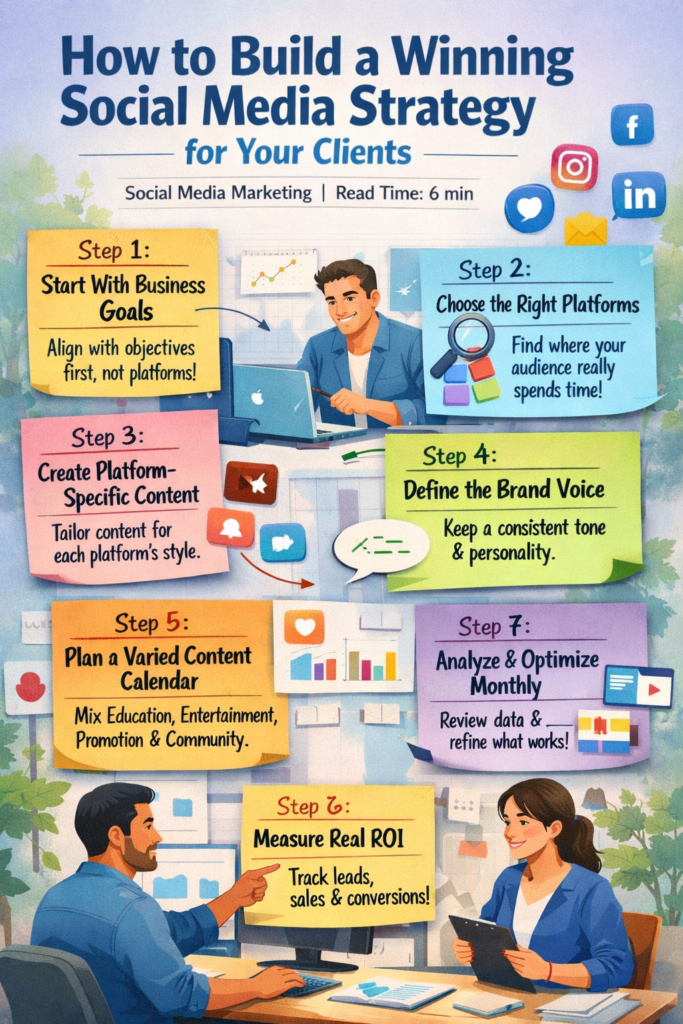
How to Build a Winning Social Media Strategy for Your Clients
Category: Social Media Marketing | Read Time: 6 min
Managing social media for clients is no longer about posting consistently and hoping for engagement. In 2026, the agencies delivering real results are those with a structured, platform-specific strategy built on data, creative excellence, and clear business objectives.
Step 1: Start With Business Goals, Not Platform Tactics
The biggest mistake agencies make is jumping straight into content calendars before understanding what the client actually needs. Is the goal brand awareness, lead generation, community building, or driving direct sales? Every platform choice, content format, and posting frequency must map back to a specific business outcome. Hold a discovery session with every new client to align on measurable goals before a single post is planned.
Step 2: Choose Platforms Based on Audience, Not Trends
Not every client needs to be on every platform. A B2B software company will see dramatically better ROI on LinkedIn than TikTok. A lifestyle brand targeting Gen Z needs Instagram Reels and TikTok, not Facebook. Agencies must conduct audience research — where does the target customer actually spend time, what content do they consume, and what platforms influence their buying decisions? Focus on two or three platforms and dominate them rather than spreading thin across six.
Step 3: Build a Platform-Specific Content Strategy
Each platform has its own content language. What works on LinkedIn fails on Instagram. What performs on TikTok gets ignored on Twitter. Agencies must create platform-native content — not repurposed versions of the same post. LinkedIn rewards long-form insights and professional storytelling. Instagram thrives on visual aesthetics and short-form video. TikTok demands authenticity, humor, and trend awareness. Pinterest drives traffic through aspirational, searchable visuals. Build a separate creative brief for each platform.
Step 4: Define Brand Voice and Maintain It Consistently
Brand voice is the personality behind every caption, comment, and story. Agencies must develop a clear voice guide for each client — defining tone (formal vs. casual), language style (technical vs. simple), and emotional register (inspiring, educational, entertaining). This guide ensures consistency whether the content is written by one team member or five, and prevents the jarring tonal shifts that erode audience trust.
Step 5: Build a Content Calendar With Variety and Purpose
A content calendar should balance four types of posts: educational content that builds authority, entertaining content that drives shares and saves, promotional content that drives conversions, and community content that generates conversation and loyalty. A common ratio that works well is 40% educational, 30% entertaining, 20% promotional, and 10% community-driven. Plan content two to four weeks in advance while leaving room for reactive, trending content.
Step 6: Use Data to Refine and Optimize Monthly
Every month, agencies must review key metrics for each client — reach, engagement rate, follower growth, click-through rate, and conversion rate. Identify the top three performing posts and understand why they worked. Identify the bottom three and understand what failed. The best social media strategies are never static — they evolve based on what the audience actually responds to, not what the agency assumes will work.
Step 7: Measure ROI Beyond Vanity Metrics
Likes and follower counts are not business results. Agencies must connect social media activity to actual business outcomes — website traffic from social channels, leads generated through social campaigns, and revenue attributed to social touchpoints. Use UTM parameters on every link, connect social analytics to the client’s CRM, and present monthly reports that speak in business language, not platform language.